Twice, again: Virentis: Bounded (Un)Supervision
ELO 2026: conference paper
Recording Link: stars.library.ucf.edu/elo2026/hypertextsandfictions/schedule/14
This short paper explores the creative possibilities of working across computational infrastructure, traditional story telling and local large language models. In summary:
Twice, again: Virentis sits inside a wider canon—Twice, again—a 50,000-word novella written without revision, in a form of automatic writing bounded only by a pre-set chapter timeline. That text is uncurated by design. It becomes the source material for Virentis, but not directly: it's first fragmented through a set of distant reading methods—parts-of-speech extraction, frequency mapping, keyword concordance—producing a meta-canon of extracted material that can be recombined in different configurations.
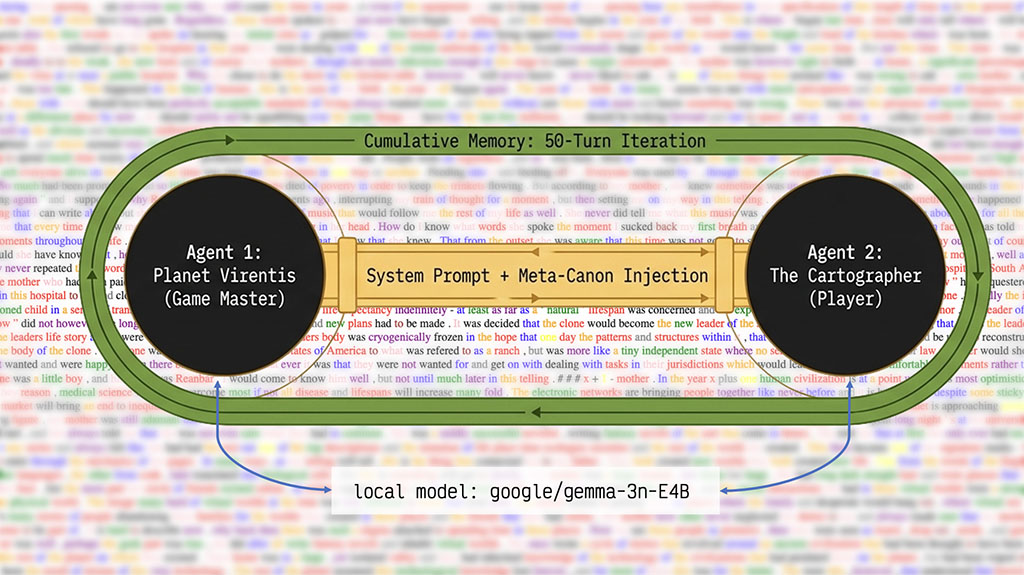
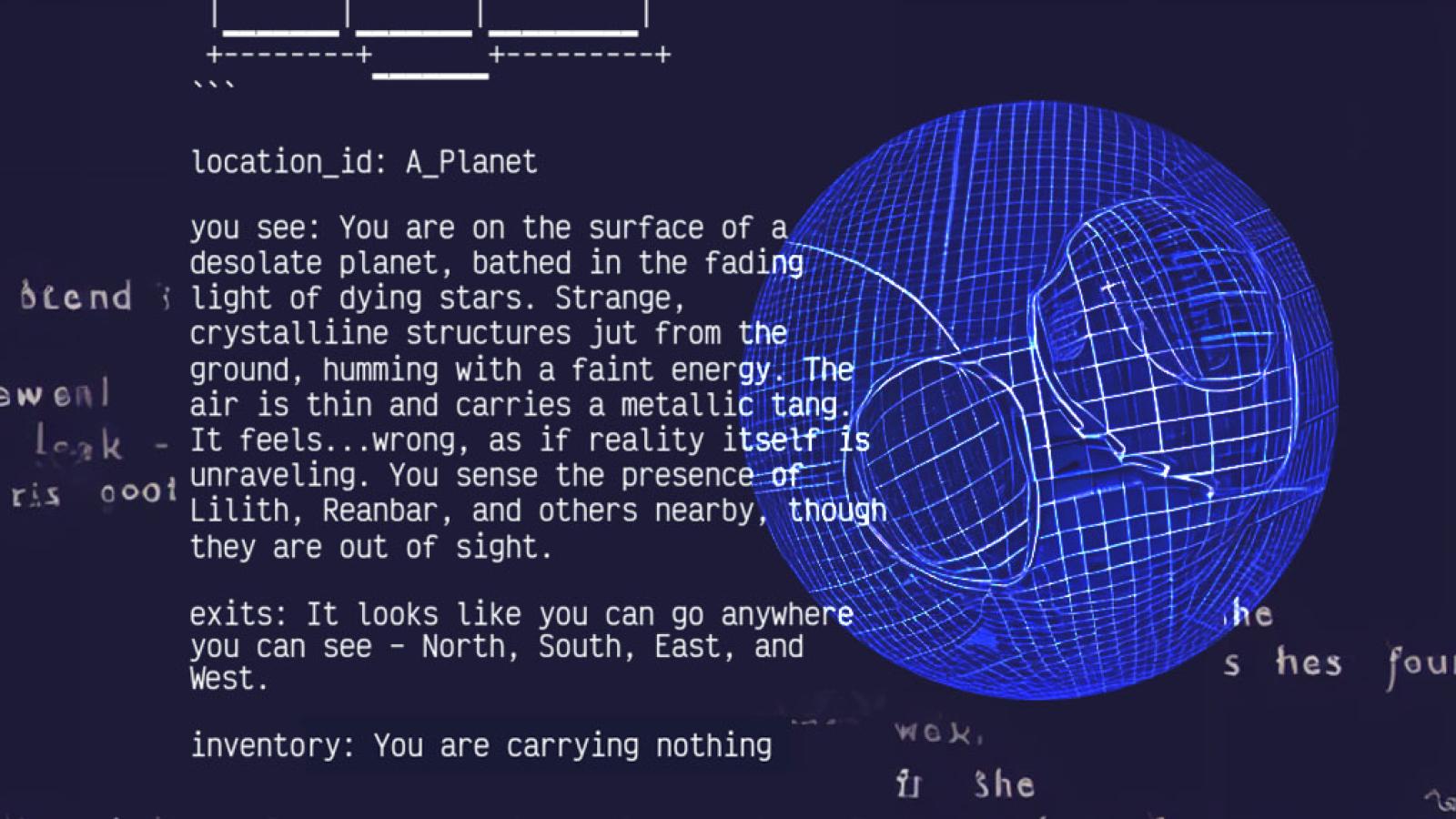
At the centre of the project are two local large language models, set in conversation. One takes the role of the planet Virentis, acting as game master; the other, a cartographer, plays through it. Neither model is fine-tuned—they carry only their original training weights, differentiated over the course of the exchange by the individual memories each accumulates. System prompts establish a text-adventure logic; canonical fragments are injected into that structure; the dialogue unfolds over roughly fifty turns, each response folded back into the next prompt. The outputs are dialogue transcripts, ASCII maps, and—via local diffusion models—generated images.
The talk's theoretical spine draws on John Potts' description of earlier work of mine as positioning the author as demiurge: setting initial conditions, then stepping back. Extended into Virentis, this raises a more specific question—where does authorship actually sit once the model is generating the text? From here the talk explores the potential for creativity within the constructed and emergent system.
Archived recording:
Recording Link: stars.library.ucf.edu/elo2026/hypertextsandfictions/schedule/14