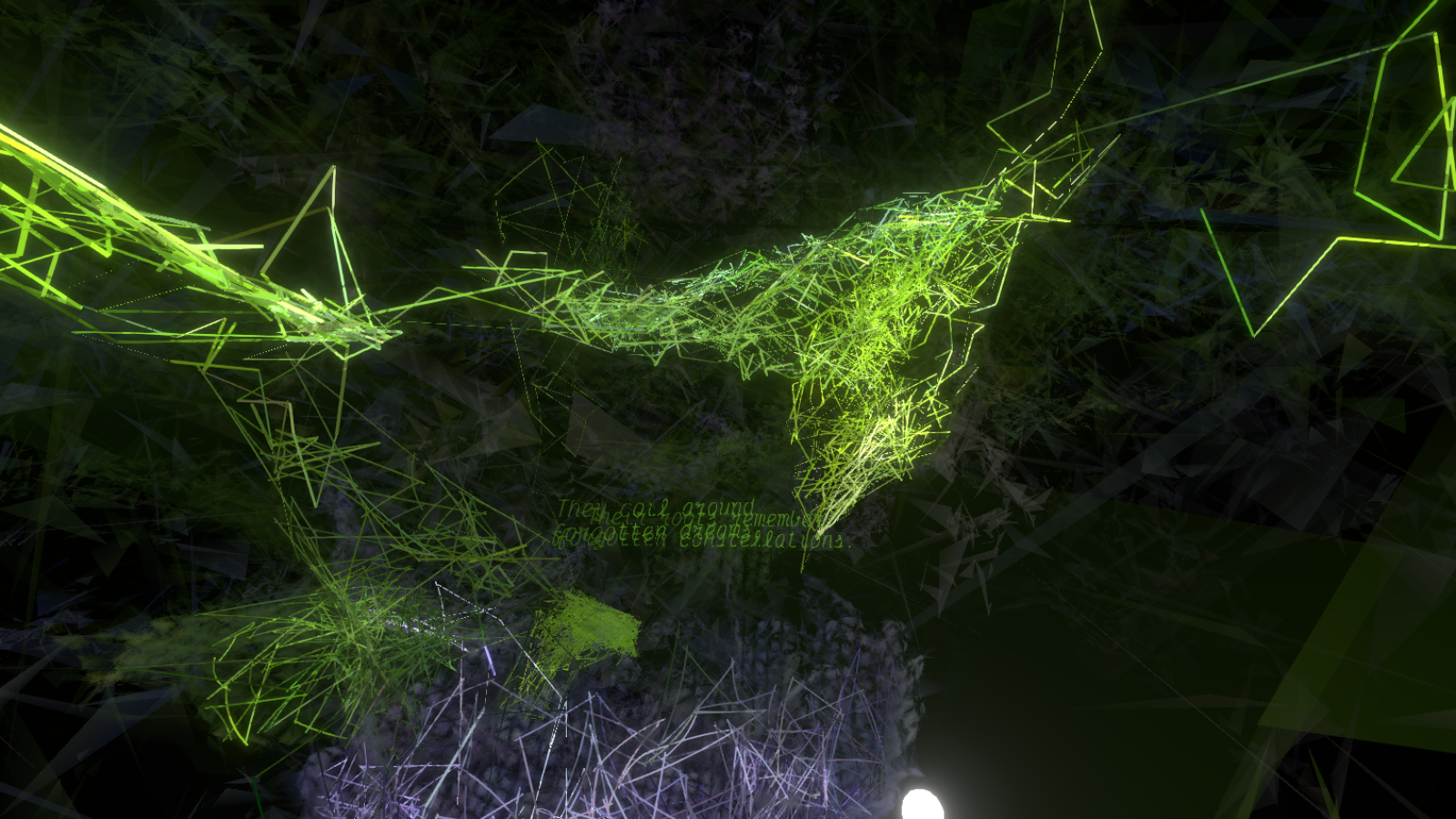
Into the Xenotone: XenoBase experiment
The first experiment that led towards the current form of "Into the Xenotone"
introduction
Into the Xenotone did not start with the current iteration of the work. As with any research-led iterative, speculative, design work, it emerged from process and a series of experiments that built on each other. The initial premise that survived through all of the experiments is that Into the Xenotone would build worlds, where coloured point clouds derived from gaussian splats of physical ecologies, are treated as navigable, living substrates. This substrate is traversed by virtual creatures with their actions influenced by any number of physical elements including the presence of a viewer.
Some of these original experiments created striking visuals as the original points clouds were replaced by the paths of these creatures. The first of these experiments is outlined below—you can see some of the foundations for the current work here. I will write about the form the code takes in another post.
XenoBase
The foundational experiment. Two virtual creatures move through the point cloud simultaneously. Each leaves behind it a glowing trail. At every step each creature samples a thousand random points nearby, scores them by a weighted combination of distance between the creature and the point, and colour similarity to the creature’s current position. It then moves to whichever candidate scores lowest.
Creatures can be tuned to follow colour very tightly (eg: colorWeight: 10) or more loosely (eg: colorWeight: 0.5), so the two traces can take on a different character based on this tuning.
Additionally, a viewer (using a mouse) can reach into the world and leave their own trace by selecting locations for a local LLM poem to be written in the world. At the selection point the system reads the surface normal direction and the vertex colour, converts these into plain-language descriptions ("northeastward, angling upward", "muted green"), and sends a prompt to a locally running Ollama model asking it to name that location in one unpunctuated sentence. The resulting text appears as floating 3D typography and the line is fed back into the LLM to continue the generation of the in-world text over time.
A full prompt to the model looks like this:You are naming a point in a living world. The surface faces northeastward, angling upward. Its colour is deep green. Reply with a short English sentence that feels true to this place. No punctuation, no explanation. Think laterally, try for novelty and resonance.
And then for the feedback loop:Here is text written about a point in a living world: "the moss keeps a north face colder than the stone it forgets". Continue it with one more short sentence. Only reply with the new sentence, not the full text. Same voice. No punctuation. Think laterally, try for novelty and resonance.
For consistency, the local LLM model I am working with across all of the experiments is: gemma3n:e4b