Attending to the xenotone
notes towards early ventures into the emerging xenotone.
The xenotone does not follow a path, paths form through the xenotone. The encounter with the xenotone happens when physical, digital and speculative paths cross—this crossing need not form an alignment.

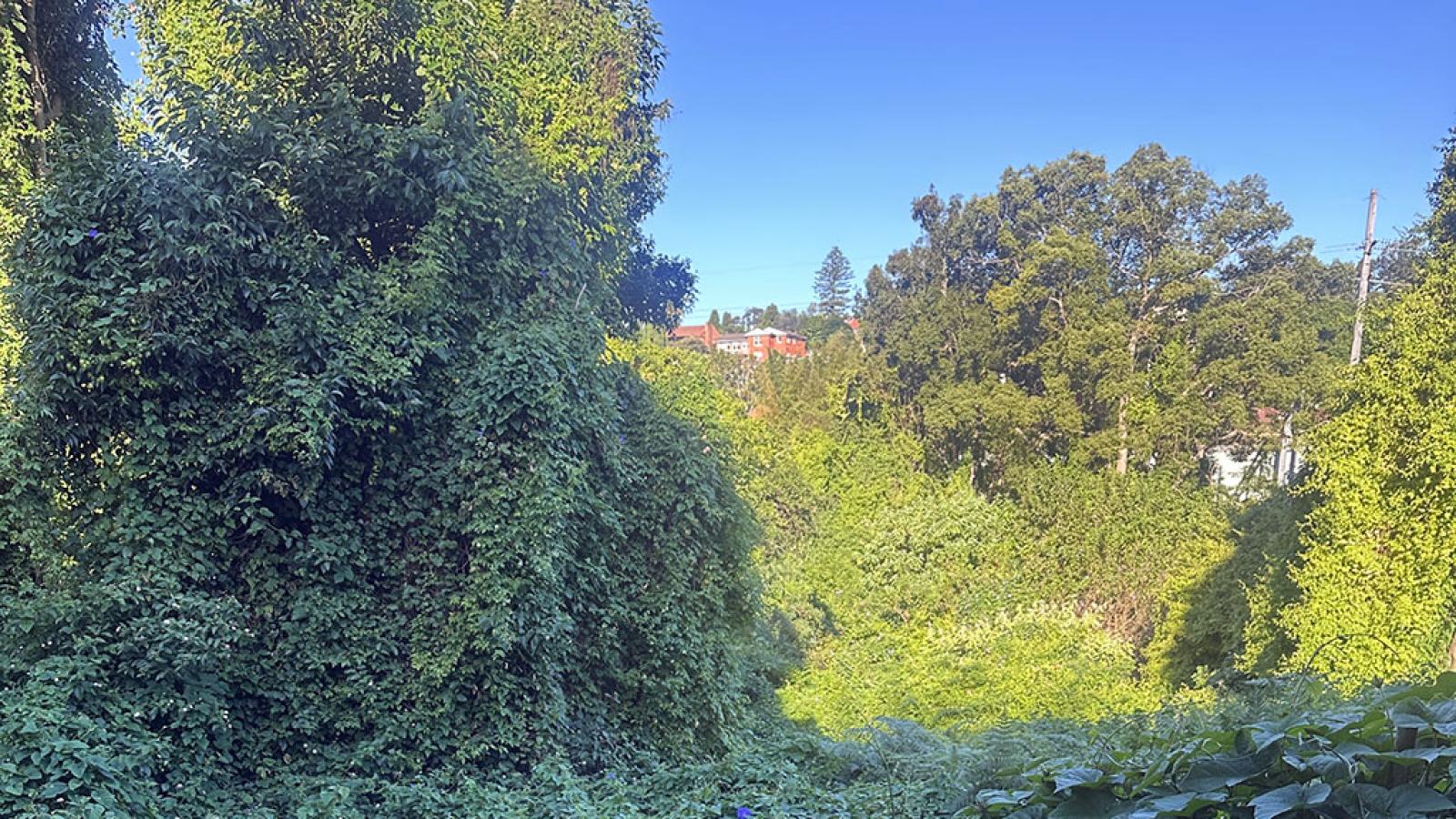
I've been walking and scanning the local remnant and reconstructed ecologies with photogrammetry, LiDAR and as Gaussian Splats for many years now. In this current iteration of experiments, Xenotone, I have been modulating the results between rudimentary point clouds and abstracted, low-poly models and the generative traversal of these.
Fundamentally, point clouds exist as a list of three-dimensional coordinate data, alongside an rgb colour sampled from the original capture. They're not meshes, just a cloud of coloured dots suspended in virtual space that, at the right density, read as a thing, or a reflection of a thing. The low-polygon models are reconstructed from these point clouds, a further step of abstraction away from their source. Surfaces reappear but are anything but solid.
It is this accumulated distance from source—scan to point cloud to mesh—that creates one of the conditions for the xenotone to appear.

These assets become the raw material for worlds built as sites for the exploration of the xenotone. The soft and malleable edges where the physical and digital ecologies overlap, and the traces of the bodies that have formed paths through it act, manifesting in a series of screen-based experiments.
Each experiment creates conditions for the walking archive to become something else: not a record of a place, but a site where the physical and digital ecologies can be thought through together, and where that thinking takes on form in the speculative space of the xenotone.
