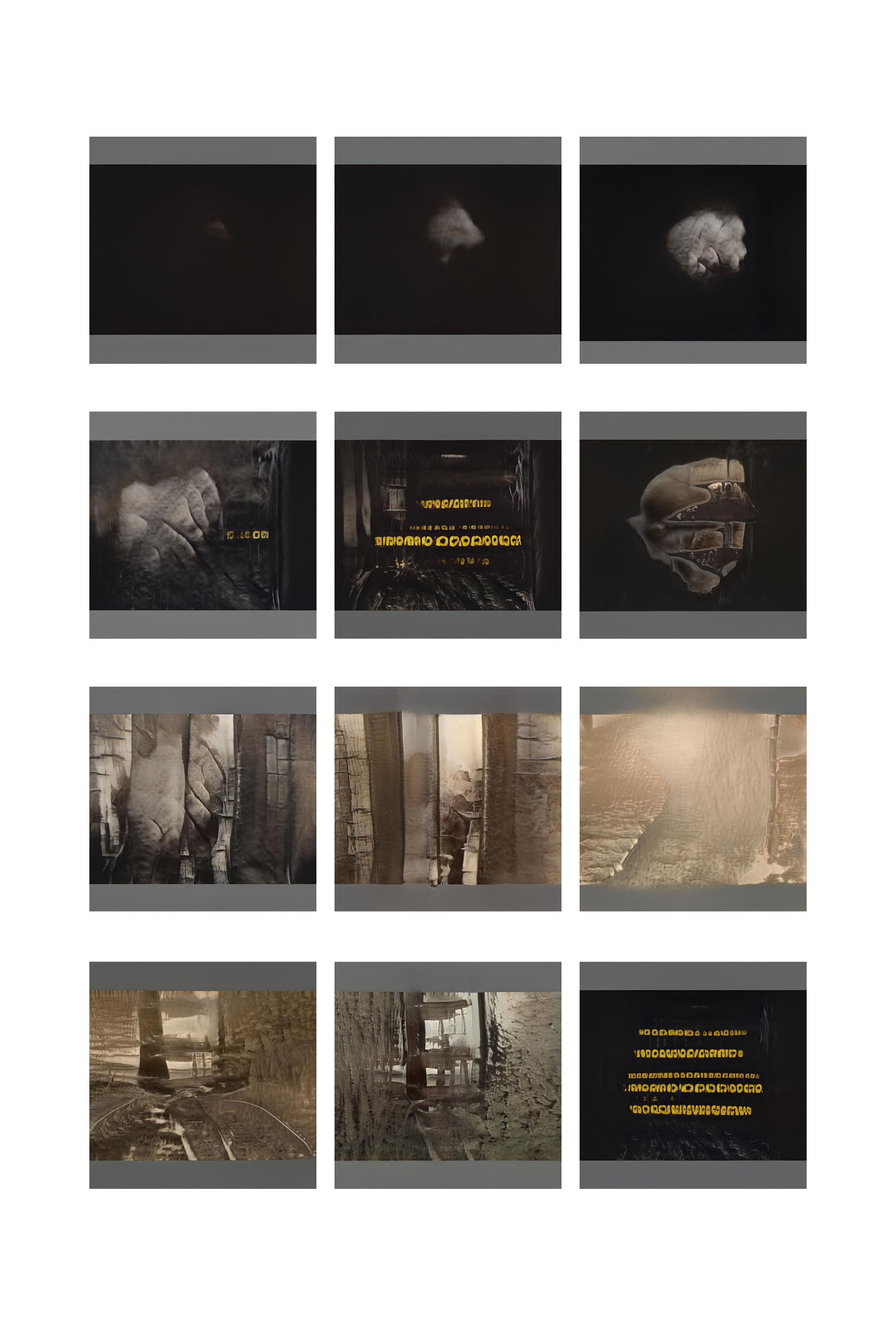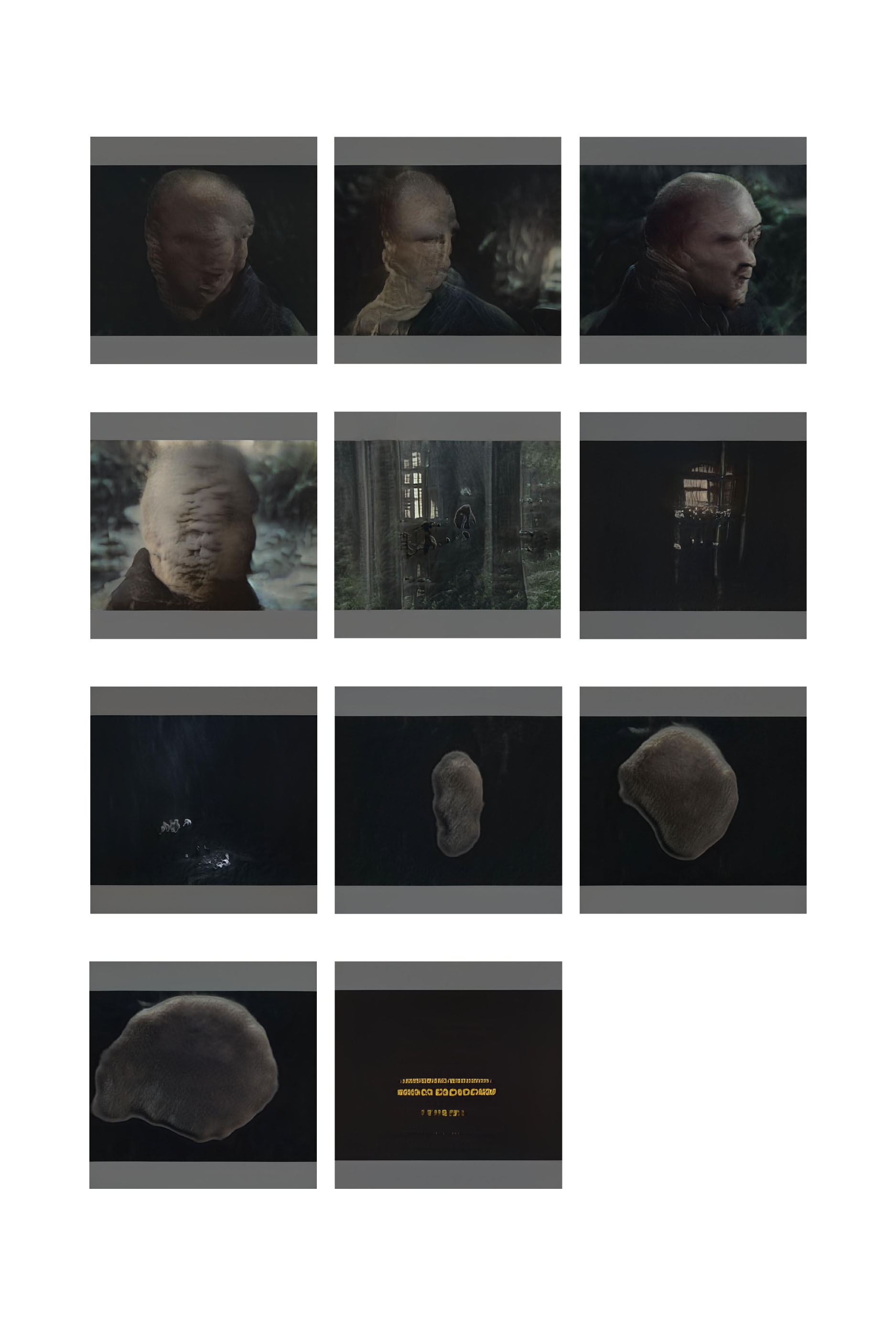
Imaginable Worlds from Imagined Worlds: Latent film stills (1979/2020)
Part of the "Cinematic Time and Space" creative research series.
Imaginable Worlds from Imagined Worlds: Latent film stills (1979/2020)
Ever since my first viewing in a long-disappeared art-house cinema, the post-alien-encounter world of Tarkovsky's 1979 film Stalker mixes with other remembered worlds in the peripheral tracts of my imagination. It is the sort of film where nothing happens, yet everything happens. The sort of film that, through lack of practice (and to my own great lament), I have lost the ability to view in one sitting. A man disappoints his wife, meets up with two other men, they drink a beer, enter a forbidden zone looking for a room that grants them their every desire, wander, argue, lose, and then find their belongings and then, something we don't see takes place and they are back where they started. The original man's child displays signs of a mysterious new power and the credits roll.
I could rewrite this narrative in many ways, and each would be correct, yet none would faithfully summarise my own imaginings of the world built over two hours and forty-three minutes. With each viewing (of which there have been many) I am left with a lingering melancholia, perhaps a direct result of this imagined world being built in something close to real-time, which I can never quite grasp, yet know contains something truly magical—the type of magic Arthur C. Clarke spoke of as being indiscernible from any sufficiently advanced technology—or was that the other way around?
The visual essay Imaginable Worlds from Imagined Worlds: Latent film stills (1979/2020) is the result of my collaboration with a number of computers, programs and algorithms to re-imagine the world of Stalker. First, I asked my computer to watch the entire digitised film and every second capture a frame. All the resulting images (close to 10,000) I uploaded to Google Photos and, in a few days, google had classified the images using its machine learning and computer vision algorithms. This meant I could ask Google for all the ‘selfies,’ ‘landscapes,’ ‘people,’ ‘doorways and windows,’ or ‘titles’ in Stalker and even for everything "green" or that is a "straight line" in Stalker.
The process of classification is given over to the classification algorithms which, in their current guise, play a central role in shaping the way many of us form and curate our own triggers of memory. Sets of images curated in this way are then used to train a machine learning model (StyleGAN2) that, in simplistic terms, keeps trying to trick another "adversarial" machine learning model, into believing that the images it produces are from the original image set that I gave it. “They” have learned how to do this through many epochs of trial and error, using images sourced from the commons—the collected photographic memories of those of us sharing our photographic archives online with permissive sharing settings. As a result, a new world emerges. A liminal space between liminal spaces. Mediated via the co-creation process between myself and the digital systems. A site of transition emerges—one of the many possible imaginable worlds—connecting a moment in 1979, with a moment now, a shared melancholia of a world in ruins, and a glimpse of the potential for an imagined magic to lift us out of this ruin—an older magic, perhaps one currently indiscernible from the technology of our own making.
What emerges is not simply a reconstruction of Stalker, but a meditation on how memory (human and algorithmic) rebuilds the ruins of time into something still becoming.
Intended for print publication as a small pamphlet, (an) outcome is reproduced digitally here.